 |
Piper J-3 Cub / O-59 / L-4 Grasshopper1937 |  |
| LIGHTPLANE | Virtual Aircraft Museum / USA / Piper |
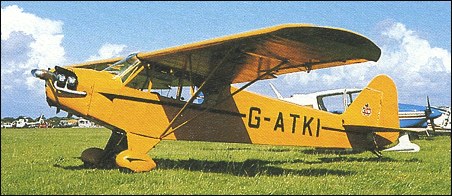 |
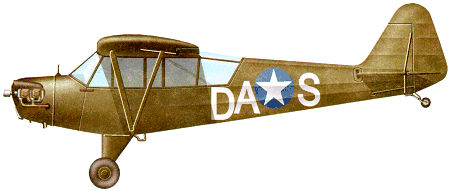
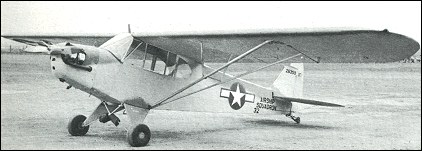
C. Gilbert Taylor and his brother had first established the Taylor Brothers Aviation Corporation in 1929 to market the Taylor Chummy lightplane; in 1931 the company was reorganised as the Taylor Aircraft Company, W. T. Piper Sr then being its secretary and treasurer. When the company ran into financial difficulties, manufacturing and marketing rights for the Taylor Cub, which had first flown in September 1930, were acquired by W. T. Piper who, in 1937, formed Piper Aircraft Corporation to continue production of this aircraft. A braced high-wing monoplane of mixed basic construction with fabric covering, the Cub had a conventional tail unit, fixed tailskid landing gear (the main units with wheels or optional floats) and an enclosed cabin seating two in tandem. When first produced by Piper, the Piper J-3 Cub was powered by a 30kW Continental A40-4 flat-four engine, but it was not long before the 37kW A50-4 or alternative A50-5 with dual ignition system was introduced on the J-3C-50 Cub. The resulting improvement in performance made this already attractive lightplane an extremely marketable commodity and during 1938, which was the new company's first full year of production, no fewer than 737 Cubs were built. The Continental A50 was a new engine, early experience proving that it was reliable and had development potential, and it was later re-rated at 48kW at a higher engine speed. Its introduction by competitors meant that Piper had to follow suit, and in 1940 the J-3C-65 Cub appeared with the Continental A65 engine. With alternative Franklin flat-four engines, the 37kW 4AC-150 or 48kW 4AC-176, the Cub was designated J-3F-50 and J-3F-65 respectively and, similarly, with the Avco Lycoming 37kW O-145-A1 or 48kW O-145-B the Cub had the respective designations J-3L-50 and J-3L-65. Also built in comparatively small numbers was a version designated J-3P-50, powered by a 37kW Lenape Papoose 3-cylinder radial engine. Sales began to soar, and then in 1941 the US Army selected this aircraft for evaluation in artillery spotting/direction roles, and shortly afterwards ordered 40 similar aircraft under the designation O-59. These aircraft.were used by the US Army under virtually operational conditions during annual manoeuvres at the end of 1941, and it was very soon discovered that the little Cub had far wider applications than at first anticipated. This practical experience enabled the US Army to obtain an improved O-59A which, powered by a 48kW Continental O-170-3 flat-four engine, had better accommodation for the pilot and observer with an enhanced all-round view. Orders for O-59As totalled 948, but as a result of designation changes they entered service as L-4A aircraft, the earlier YO-59 and O-59 aircraft then being redesignated L-4, and the type later received the name Grasshopper. Subsequent procurements covered 980 of the L-4B version with reduced radio equipment, 1,801 of the L-4H variant with only detail changes, and 1,680 of the L-4J model which introduced a variable-pitch propeller. Civil-Cubs impressed for Army service at the beginning of World War II included eight J-3C-65s and five J-3F-65s which were designated L-4C and L-4D respectively. Piper was then requested to develop a training glider from the L-4 design and this, with powerplant removed and the forward fuselage redesigned to accommodate an instructor and two pupils, was built to a total of 250 for the US Army under the designation TG-8. Three of these gliders were acquired for evaluation by the US Navy under the designation XLNP-1 and this service also procured 230 NE-1 aircraft which, basically similar to the US Army's L-4s, were used as primary trainers; 20 similar aircraft procured at a later date were designated NE-2. When, post-war, production was switched to the further improved Cub J-4 Coupe, Piper had built a total of 14,125 civil and 5,703 military.
|  COMPANY PROFILE | ||||||||||||||||||||||||||||||||||||||||||||||||

|


|
Hi Linda
I hope you’re well. I realise it’s been some years but I’m trying to contact the current owner of your late husbands Piper L4 cub. I am part of a project team for Membury airfield restoring a wartime transport aircraft and we are looking for an L4 to accompany it. I remember your husbands from when my dad used to do some as-hoc work on various vehicles for your husband when I was a kid. The aircraft is currently based, coincidentally, at my local field near Wantage. I know it’s Graham Earl who owns it and I was wondering if you have a number or email for him please?
Kind regards
Mark Young 07765 641541
reply