|
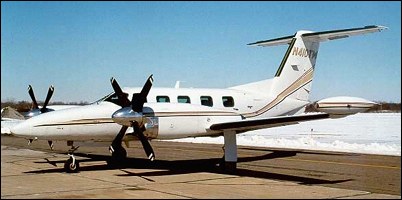
| On 30 June 1980 Piper began production deliveries of a new version of the Cheyenne range of twin turboprop aircraft. Intended for use as a 6/11-seat corporate or commuter transport, this Cheyenne III differs considerably from its predecessors, a fact reflected in the changed company designation Piper PA-42. It has a wing of increased span, lengthened fuselage, a T-tail, and more powerful Pratt & Whitney Aircraft of Canada PT6A turboprop engines installed in lengthened nacelles. The Cheyenne III remains as a current production model, being complemented by the Cheyenne IIIA which differs primarily by having 634kW PT6A-61 turboprop engines flat-rated at 537kW and offering performance improvements. In addition to the Cheyenne III, Piper was involved in the certification programme of a new Cheyenne IV during 1983, with two 1,227kW Garrett TPE331-14A/14B counter-rotating turboprop engines, each of them flat-rated at 746kW. Deliveries of the Cheyenne IV began in the early summer of 1984. It was one of the fastest propeller light twins, at over 644km/h.
The Cheyenne is one of the very few Piper products to remain in volume production after the company's financial reorganisation in 1991/92. Current versions on offer include the Cheyenne IIIA of which 59 had been delivered by early 1993. Nine Cheyenne Ills delivered to the US Drug Enforcement Administration, fitted with AN/APG-66 radar and a ventral FLIR, are used for day- and nighttime surveillance missions. They are
known as Customs High Endurance
Tracker (CHET) aircraft. Cheyenne Ills are joined at the Lock Haven production line by the PA-42-1000 Cheyenne
400. Originally the Cheyenne IV, it later became the Cheyenne 400LS. Deliveries total 43.
| MODEL | PA-42-Cheyenne III |
| CREW | 6-11 |
| ENGINE | 2 x Pratt & Whitney Aircraft of Canada PT6A-41 turboprops, 537kW |
| WEIGHTS |
| Take-off weight | 5080 kg | 11200 lb |
| Empty weight | 2898 kg | 6389 lb |
| DIMENSIONS |
| Wingspan | 14.53 m | 48 ft 8 in |
| Length | 13.23 m | 43 ft 5 in |
| Height | 4.5 m | 15 ft 9 in |
| Wing area | 27.22 m2 | 292.99 sq ft |
| PERFORMANCE |
| Max. speed | 549 km/h | 341 mph |
| Ceiling | 9755 m | 32000 ft |
| Range | 4150 km | 2579 miles |
| David Bennett, e-mail, 08.04.2024 21:25 I have pictures of N9150T and N9233T. Would you like me to email them to you. reply | | David Bennett, e-mail, 08.04.2024 21:08 N9233T was also at White Industries on 2 May 2017. reply | | David Bennett, e-mail, 11.02.2024 19:54 By 2nd May 2017, N9150T was at White Industries in Bates City and not in good shape. reply | | Mark Harrison, e-mail, 14.09.2016 01:51 Some small corrections to the article, it states that "Nine Cheyenne III delivered". There were only eight aircraft delivered fully modified and they were Cheyenne IIIA's with the PT6A-61 engines in 1986. They were designated as PA42-720R's. The eight aircraft were N9091J, N9279A, N9159Y, N9150T, N9233T, N9150T, N9142B, and N9085U. I flew six of the eight at the Miami Air Branch and Jacksonville Air Branch while they were in the inventory. The last three were retired and sold at auction in 2013 from the Jacksonville Air and Marine Branch. It had the An /AAQ16 Hughes FLIR which was upgraded to the Westcam MX-15 EOIR which was mounted in the nose extension in front of the nose landing gear.
Mark Harrison
Pilot, U.S. Customs
Retired(2011) reply | |
| | Roger Pence, e-mail, 28.01.2016 15:43 One small contradiction in this article;
Nine Cheyenne Ills delivered to the US Drug Enforcement Administration, fitted with AN /APG-66 radar and a ventral FLIR, are used for day- and nighttime surveillance missions. They are known as Customs High Endurance Tracker (CHET) aircraft.
The 9 CHET aircraft were deliver to U.S. Customs not the DEA else it would have been nicknamed DHET.
Roger Pence
U.S. Customs
Retired reply | | Waldo, e-mail, 22.08.2012 03:27 The Cheyenne III was designed and built at the Lakeland,FL plant...It was never assembled in Lock Haven reply | | J.DStewart, 23.03.2010 17:29 Correction, Garrett engines. reply | | J.D. Stewart, 23.03.2010 17:28 The photo your using for the Cheyenne III is actually a Piper Cheyenne IV, which utilized Air Research engines. reply |
|
Do you have any comments?
|
| 
COMPANY
PROFILE
All the World's Rotorcraft
|