Back Kellett XR-10
1947

Kellett XR-10

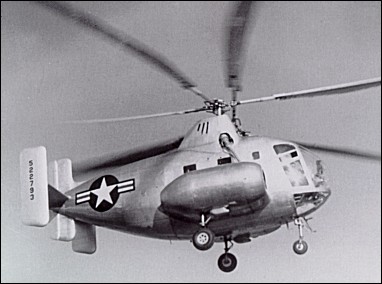
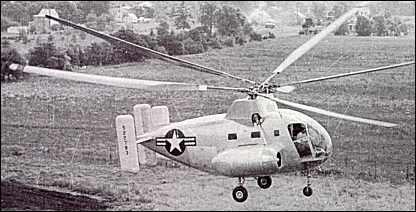
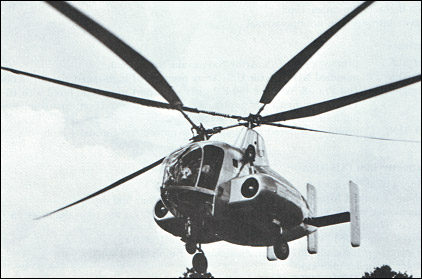
When it made its first nights in April 1947 this helicopter was the largest and most powerful designed for the United States Air Force at that time. Like the XR-8, it was of the "synchropter" type with contra-rotating and intermeshing rotors.

The rotors were driven by two engines mounted on nacelles on either side of the fuselage so as to leave the cargo space unobstructed, and cooling was by the flow of air induced through the nacelles. Rotor head linkage allowed the blades to pivot in the horizontal and vertical planes. In the horizontal plane, blade movements were damped by vibration dampers; the position of the blades was a function of the centrifugal force and the loading conditions, but there were, of course, stops to limit these movements. The rotors were synchronized through a cross drive between the upper transmissions.

One special feature of this XH-10 was its ability to fly on one engine with normal gross weight at altitudes of up to 1400 metres.

P.Lambermont "Helicopters and Autogyros of the World", 1958

Kellett XR-10

Technical data for Kellett XR-10

Crew + passengers: 10, engine: 2 x Continental R-975-15 rated at 390kW, main rotor diameter: 19.8m, max take-off weight: 6990kg, empty weight: 4341kg, max speed: 160km/h, cruising speed: 135km/h, range: 240km, endurance: 2h

Kellett XR-10

Comments 
H. Wessels, hawessels(@)hotmail.com, 03.08.2009

The rotors were synchronized via a cross-drive between the upper transmissions. If one engine failed, the remaining engine drove its own transmission as well as the opposite one, via the cross-drive.

jozsef morrissey, jozsef.morrissey(@)yahoo.com, 13.03.2009

ok im confused in the pictures it appears that the blades intersect. i know on your page it says that the motors were synchronized but i would think that if they were to the extent that the blades were interwoven that would be a characteristic more emphasized but you also state that it could run on one motor witch would not work if the blades did cross for obvious reasons. so i guess i would like an explanation or maybe a diagram witch better depicts the structural design of this machine.

thank you for your time,
jozsef

Do you have any comments concerning this aircraft ?

Name   E-mail


All the World's Rotorcraft


Virtual Aircraft Museum


Back AVIATION TOP 100 - www.avitop.com Avitop.com