 |
Morane-Saulnier M.S.4051935 |  |
| FIGHTER | Virtual Aircraft Museum / France / Morane-Saulnier |
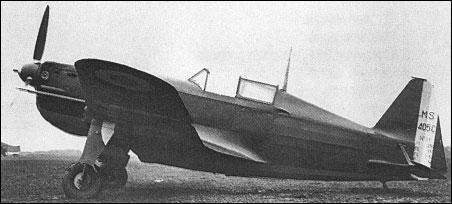 |
Designed in response to a C1 requirement initially issued in September 1934, the M.S.405 was of classic tubular metal construction, but unusual in that, other than the fabric-covered rear fuselage, it had Plymax - okoume plywood bonded to aluminium - stressed skinning. Powered by an 860hp Hispano-Suiza 12Ygrs engine, the first prototype flew on 8 August 1935, and the second, with a 900hp HS 12Ycrs, 17 months later, on 20 January 1937. A pre-series of 16 aircraft was ordered on 1 March 1937, the first flying on 3 February 1938 with an HS 12Ygrs engine and an armament of one 20mm and two 7.5mm guns. Various changes had been proposed meanwhile for the series model to which the designation M.S.406 was assigned, the new features being progressively introduced on successive M.S.405s (eg, the second featured an enlarged fuel tank, the fourth was fitted with the HS 12Y31 engine and the 12th had a simplified and lightened wing structure). The HS 12Y31-engined 13th and 15th aircraft were delivered to Switzerland (as M.S.406Hs) in September 1938 and April 1939 as pattern aircraft for a licence-built version (D-3800). The 12th was subsequently re-engined with a 910hp HS 12Y45 and fitted with a fixed rather than semi-retractable radiator as the M.S.411 to provide a basis for the HS 12Y51-engined M.S.412 built in Switzerland as the D-3801. The final M.S.405 was flown on 21 June 1938 as a pattern aircraft for the series M.S.406.
|  COMPANY PROFILE | ||||||||||||||||||||||||||||||||||||||
|


|