 |
Tupolev ANT-20 Maxim Gorki1934 |  |
| PASSENGER | Virtual Aircraft Museum / USSR / Russia / Tupolev |
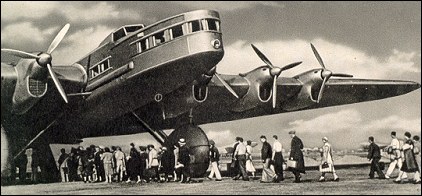 |
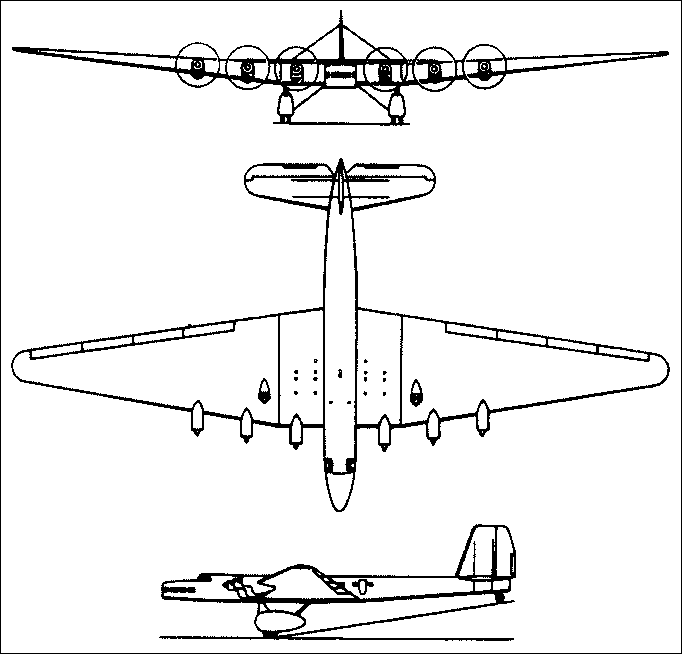
Built entirely for propaganda purposes at the behest of the Union of Soviet Writers and Editors to celebrate the career of the writer Maxim Gorkii (or Gorky), and paid for by public subscription, the giant ANT-20 toured the otherwise inaccessible areas of the USSR, bringing the communist message to the masses. To this end, the ANT-20 contained a small printing plant, a photographic studio, a cinema and a radio station. Of course, to show the wider world the superiority of Soviet aeronautics, the Maxim Gorkii had to be the largest aircraft in the world. Only a few subsequent aircraft (such as the B-36 and the An-124) have had greater wingspans. The six engines originally fitted were not enough and an extra pair were added on a pod above the fuselage. The Maxim Gorkii was lost when a Polikarpov I-5 fighter plane attempted a barrel roll around it. The fighter pilot, all 49 occupants of the ANT-20 and three people on the ground perished. Jim Winchester "The World's Worst Aircraft", 2005 FACTS AND FIGURES © As well as its media production and output capabilities, the ANT-20 had a cafeteria, an internal telephone exchange and sleeping accommodation for the crew. Some sources say it also had a laundry, a pharmacy and a bar. © Four smaller auxiliary engines were required to drive various devices, including the giant sound system and a series of lights for displaying propaganda slogans at night. © Six of the engines were mounted on the leading edge and the other two in a pusher-puller pod located above the rear fuselage. © The giant wheel spats were probably the largest ever fitted to an aircraft. © The crew is said to have been up to 23 people, although most of these were associated with the propaganda function. Between eight and 10 crew were involved in actually operating the aircraft. Tupolev ANT-20 "Maxim Gorki" on YOUTUBE
Vahe David Demirjian, e-mail, 23.12.2022  Sergei SergeiYou're definitely right, but the ANT-20bis and first ANT-20 nevertheless had the same airframe despite the second aircraft having a vertical stabilizer with a slightly different shape than the first aircraft. Vahe David Demirjian, e-mail, 23.12.2022 Sgt.KAR98The Soviet Union had a modern heavy bomber in World War II, the Petlyakov Pe-8 (TB-7), of which one aircraft was used by Stalin's top diplomat, Vyacheslav Molotov, to fly to the UK and US for negotiations to open up a second front against Nazi Germany in western Europe. However, only 93 Pe-8s were built, because most Soviet combat aviation in World War II involved tactical combat aircraft.
|  COMPANY PROFILE | ||||||||||||||||||||||||||||||||||||||||||||||||||||||||||||
|


|
There were two ANT-20s built, not three. The first ANT-20 had eight engines and was the one that collided with an escorting I-5. The second ANT-20 (PS-124) was a passenger aircraft with six M-34FRNV (later AM-35s), and it had a longer life than the first ANT-20, although it crashed in Uzbekistan after the pilot allowed a passenger to take his seat and the passenger apparently disengaged the automatic pilot.
reply