 |
Tupolev 82 / Tu-221949 |  |
| JET BOMBER | Virtual Aircraft Museum / USSR / Russia / Tupolev |
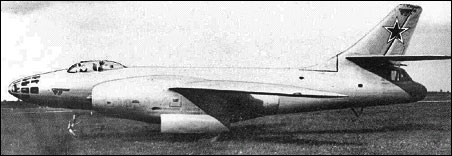 |
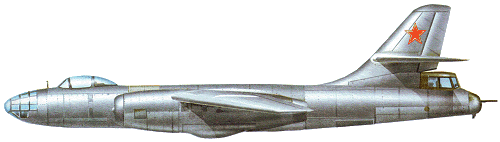
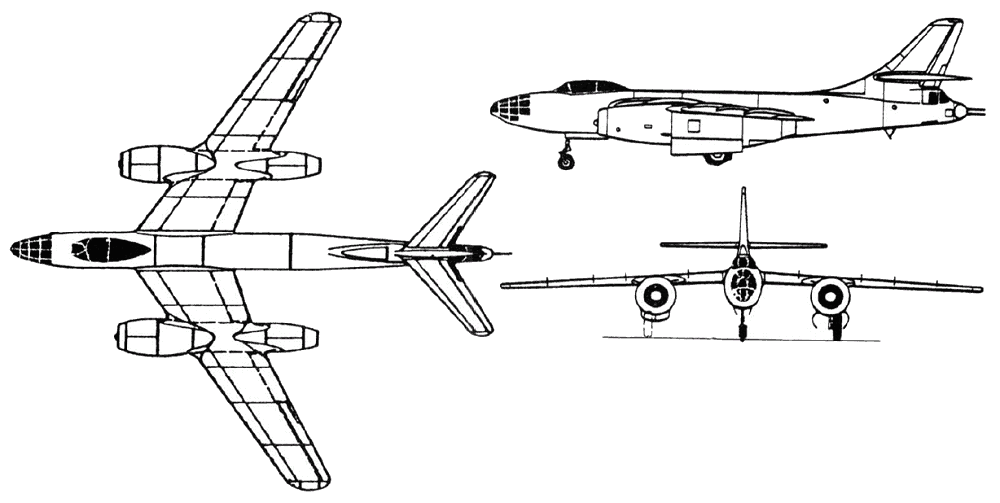
Continuing his development of jet bombers, the next Tupolev aircraft was the light twin-engined Tu-82, which was the first Soviet bomber to feature swept wings. Sergei Yeger continued as project leader, and he incorporated a wing with a sweep of 35°; while the Tu-14 range had already featured a swept-back horizontal tailplane, the Tu-82 also had the fin swept at an angle of 40°. Engines were two Nene derivative VK-1s of 2,740kg. The Tu-82 was provisionally given the designation Tu-22 by the VVS. This was not used for long, although there are photographs available to show that it was painted on the aircraft for a while; later the Tu-22 designation would be used again (and again). Conceived as a test and development aircraft for the purpose of determining the flight qualities of large swept-wing aircraft, only the single example constructed at the design works was built. Construction began at the end of 1947, and the aircraft was completed at the beginning of 1949. It made its first flight from Zhukovski on 24 March. Its performance was good. Maximum speed was established to be 934km/h, service ceiling was an excellent 14,000m, and range 2,750km. A relatively small aircraft, the Tu-82 had an empty weight of just 9,526kg, compared to the more than 14,000kg of the three-engine jets of the family. Its normal take-off weight was 13,000kg, but it had little difficulty in performance when this was increased to 18,000kg. A production version of the Tu-82 was planned, the slightly bigger Tu-86, but the programme was cancelled.
|  COMPANY PROFILE | ||||||||||||||||||||||||||||||||||||||||||||||||||||||||||
|


|