|
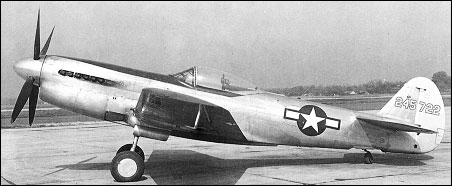
| Prior to the final termination of P-40 development, some
effort was expended in combining aerodynamic refinement
with increased power to produce a higher-performance
model. A P-40K airframe was fitted with an
Allison V-1710-121 engine rated at 1,425hp for take-off
and 1,100hp at 7620m. Semi-flush low-drag
radiators were incorporated in the wing centre section
and a four-bladed propeller was fitted, the designation
XP-40Q being assigned. A second, similarly re-engined
P-40K for the P-40Q programme reintroduced the nose
radiator scoop, but featured an all-round vision bubble-type
canopy (previously tested on a P-40N). The definitive
XP-40Q (converted from a P-40N-25 airframe) had
clipped wing tips, the cut-down aft fuselage with bubble
canopy and coolant radiators faired into the wing
leading edges. Four 12.7mm guns were carried
but proposed production models were to have carried,
either six 12.7mm or four 20mm weapons. No
production was undertaken.
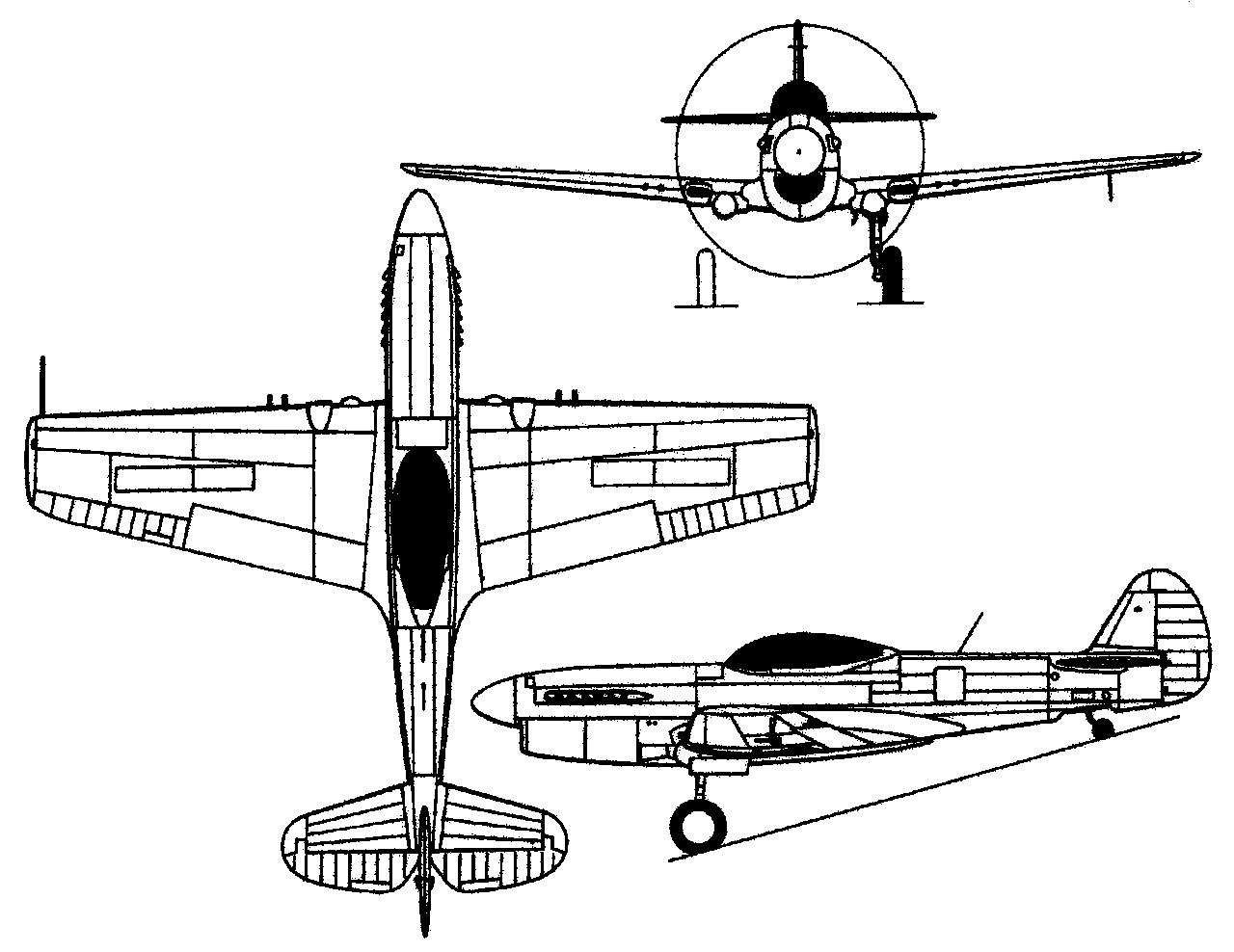
 | A three-view drawing (1280 x 988) |
| DIMENSIONS |
| Wingspan | 10.75 m | 35 ft 3 in |
| Length | 10.16 m | 33 ft 4 in |
| PERFORMANCE |
| Max. speed | 679 km/h | 422 mph |
| g.beindian@hotmail.com, e-mail, 31.07.2023 04:54 IF I'M ,CORRECT,THERE WERE TWO XP-40Q "WARHAWKS" WHICH WERE BUILT [PROTOTYPES ONLY].THE XP-40Q DID REACH A MAXIMUM SPEED OF 422mph.THEY WERE BOTH SCRAPPED AFTER WW2 ENDED.
IN MY MIND THE XP-40Q SHOULD'VE BEEN PUT INTO FULL PRODUCTION.THE P-40Q, LIKE ALL THE P-40 "WARHAWK" SERIES WOULD'VE BEEN AN EXCELLENT LIGHT ATTACK AIRCRAFT [STRAFING,LIGHT BOMBING].THE MAIN FIGHTERS OF WW2 ON THE SIDE OF THE ALLIES WERE THE P-51 "MUSTANG",P-47 "THUNDERBOLT",P-38 "LIGHTNING",GRUMMAN F6F "HELLCAT" [ANOTHER OUSTANDING PLANE] AND THE VOUGHT F4U "CORSAIR". reply | | Ray Cox, e-mail, 08.04.2021 08:56 "Hap" Arnold, nor anyone else, "impeded" the P-40Q. The P-40Q had a top speed of 422 mph, but at the same time a production P-47D had a top speed of 433 mph, and a production P-51D could go 437 mph. Also, the P-40Q's service ceiling was 31,000 ft, but the service ceiling for the P-47D was 40,000 ft, and the P51D was 41,500 ft. The performance of the P-40Q was simply inferior to the P-47s and P-51s already in service. That was the reason why the P-40Q was not put into production. reply | | arrowBFlight, e-mail, 02.04.2017 21:27 It makes one wonder. 'Hap' Arnold probably did more to
impede this a /c, that had so much potential. There was
ample time to sort out a half dozen or less items on
this a /c. Get weapons clearance done ( 4-20mm cannons,
75 gal lrt, tote a pair of 500 pounders ) put her in the
field, and let her run a muck. This was a much improved
P-40. She could turn and roll well, had a significant
increase in airspeed, diving was never really an issue,
and now, she could climb! Case in point; The Tempest V
was delayed for months over a pay dispute by assembly
workers at Langley. Tempests arrived in Feb /Mar of '45
and in a short period of time did a bang up job! LWP'S
feared and respected Tempests. It scared the living
day lights out of them. The XP-40, should have been given
the green light. What could have been ? Boggles the mind. reply | | arrow, e-mail, 15.05.2016 19:36 Touche,Boris. Thanks for the reminder. I forgot about that
formula, torque x rpm divided by 5252 = H.P. All of the
engine constructors during that period used dynomometers,
and the h.p. rating was at 3000 rpm at sea level for take
off. These v-12's produced some serious 'grunt'. I've
recently come by some images of a dyno cell at Allison.
Some h.d. plumbing,air ducting, and the water brake was
huge by large ! It looks like a generator from G.E. and
is a good 4'ft in diameter. I guess Allison and others
chose not to advertise these figures.Impressive all the
same. I've also found some great info on p-40's, lots of
test data et al, to much to go over here, however there
is a good piece on how hard the v-1710-39 and 73 series
engines could be pushed, ie:'over boosting' by the ausies. Try 66"hg m.p.= 18lbs boost on the 39 and 70"m.p.
for 20lbs boost on the 73 for extended periods @ 3200rpm
Allison reps. estimated the engines were making north of
1700 h.p. That would make for one screamin' hawk !
it's all good. reply | |
| | Boris, e-mail, 01.05.2016 04:04 I picked 1700HP @ 3,000 RPM.
It is pretty simple.
about 2976 ft lbs at that speed. reply | | arrow, e-mail, 07.04.2016 01:08 good answer. it makes sense. as for torque /thrust values
they may very well not exist. if by chance they do, i think the numbers would be interesting. allison used
supercharger ratios from a low 0f 6.00:1 with a mix of
ratios, topping out at 9.:80.1 . during the depression
era, i believe g.m did little if any r & d on the allison. rolls royce did. rolls had one other advantage
going for them. they were involved in the schnieder cup
air races. much was learned from this, no doubt. i think
it was in 1937, one of the supermarine a /c achieved an
airspeed of 430mph, in a /c equiped with floats no less.
they were on the right track, to be sure. history is,
as history was. if not for if's, but's, and maybe, things
would certainly be different. take care. reply | | Boris, e-mail, 31.03.2016 17:38 In aircraft engines Horse Power is converted to the desired
"torque" and thrust by gear reduction and controllable propeller pitch. So the rated torque is un important.
A good example would be turbo prop engines. Th eturbines are turning at 13,000RPM + but the prop is turning about 1,100 RPM.
Similar for WWII era piston engines, most had a gear reduction of between 1.33:1 and 3:1
As far as I know Allison V-1710s were equipped with 1.5:1 (prop turning slower than the engine) gear reduction and 7.3:1 or 8:1 blower drive ratio. ALL airworthy Allison V-1710 engines were supercharged. Some, like the one in the P-40Q had a two stage unit and the P-38 had a turbo supercharger as a first stage along with the gear driven blower. reply | | arrow, e-mail, 20.03.2016 00:23 there was a u.s. gen. who once said" the p-40 was damned by
words, but was flown into glory".i have not been able to find out who this general was, however i feel he was right.
the p-40 was a much better a /c than many have given her credit for. she was the only fighter that could turn with the a6m zero. a move known as low yo - yo. she could roll
with best of them, dive like brick, and dish out a beating as well as take a pounding that would finish off others, yet more often that not, return to base. as for the p-40q. as stated else were, to little to late. however, had events taken place sooner she may have seen the light of day. i guess we 'll never know. the "q" ship
looked to be quite the performer. angels 20 could be attained in 4.8 min. that's a r.o.c of 4,167ft /min. that's nothing to sneeze at. with 4 20mm cannons, 1425 hp
422mph at full chat, yeah ! add h2o /meth injection and you have a 20% boost in h.p. that's 1 h.p. /per cu inch.
back in the day, that was magical ! the p-40, her pilots, and the g /c's did a great job. to all of those great guys
thank you. in closing, we all know the h.p rating of those beautiful v-12's, works of art. does anyone know
what the torque rating was in lb /ft of an allison v-12
1710-121 or other allison's ? h.p. is all good but, torque is what gets you moving ! have fun, and take care reply | | Boris, e-mail, 03.01.2016 20:06 Also the Oscar and more so the zero could not turn right worth beans at full power at any speed. This was easily compensated for at low speeds but at over 250 mph they were at full or nearly full power.
As far as I know no version of the P-40 had flight control boost. Flight control boost was a rare thing in piston engine fighters. reply | | Ed Foster, e-mail, 20.12.2015 20:59 The P-40 was the only Allied fighter that could out turn the Zero or Oscar at speeds above about 280 m.p.h. The lack of hydraulic boost on Japanese aircraft controls meant their maneuverability suffered at speeds near or above 300 m.p.h. Saburo Sakai would order his pilots to break off rather than engage Australian or New Zealand P-40's in high speed turning matches. reply | | TORBJÖRN KAMPE, e-mail, 08.03.2015 00:01 P-40 war the United States ever airplanes that are worthy of the name fighters. It was as long in the air like me-109 and FW-190, spitfirer and hurrkan.
P-40Q is not fun that it had to be with WW2, but was RENO aircraft. Boring.
Everyone talks about the P-51 Mustang, the beginning of WW2, was the only one attack aircraft named A-36 Aptche. US only real jack plane, the P-40. reply | | Boris, e-mail, 14.11.2013 02:18 oh yes, I had forgotten, Kermitt Weeks is restoring a Fury V powered by a 2,400 hp Sabre. The aircraft will be fully airworthy and have a (maybe at this point) running Sabre. Kermitt admitts it will never fly though we may get to see and hear a running Sabre for the first time in half a century. Reason for not chancing a flight? The legendary "reliability" of Napier's masterpiece!
Boris reply | | Boris, e-mail, 13.11.2013 00:56 P-51 and that "lousy Allison"?
The P-51A and A-36 were powered by an up-rated V-1710-81
that gave better performance and speed rose to 408mph@15,000'.
Some say 390 mph, but I tend to believe the USAAC /USAAF
numbers at 408.
To put that in perspective the A model was the best performing
version of the P-51 under 10,000' till the H model came around.
Above 10,000' the two stage Merlin ruled.
Boris reply | | Sven, 04.11.2013 01:19 I think Boris just about
Nailed it.A different
engine doesn't make a
different aeroplane.
Before anyone says P51.
Exeptions are there for all to see but as rare
as rocking horse manure reply | |
| | Boris, e-mail, 03.11.2013 20:22 Napier's 3,500HP Sabre was a running but still born project.
Sleeve valve engines did not tolerate high boost pressures
well at all and the Sabre at 3,500HP would likely have never
survived in service. In any event the advent of 100+ PN (octane)
fuels made poppet valve engines a more viable option. As much
as I admire the British Sleeve valve en gines they were extremely
costly to build and operate. Roughly twice the operating and
purchase price of equivalent poppet valve engines. If you want
to talk one off fantasy piston engines there were dozens
of candidates from the P&W 4200 hp R-4360 VDT to the previously
mentioned Allison Turbo compounded engines.
Curtiss Wright built the awesome R-3350 TCW series of radials
that made between 3,250 and 3,800 HP! In service to boot.
Mass produced and used in everyday service....
Sabres are cool, but utterly unreliable at any power setting.
When WWII ended so did the Sabre, as far as i know there are
NO running Sabres static or otherwise, and for good reason.
The highest power output for a Sabre in regular service was the Sabre V at around 2,500-2,600 HP.
Weight was decidedly piggish at over 2,350 lbs for the
power unit only.
Allison weight was about 1,400 lbs depending on model.
As a result Sabre installation in a P-40 would have been
an impossability. reply | | Steve Round, e-mail, 03.11.2013 04:43 Ever heard of the Napier Sabre IV 24 cylinder sleeve valve 3500 horsepower no more frontal area than a Merlin and barely 8 ft long the Napier would have made this kite go some reply | | juan, e-mail, 30.03.2012 19:30 Fue una hermosa maquina de limpia arquitectura americana
Literalmente una joya de la mecanica reply | | Klaatu83, e-mail, 22.12.2011 19:08 The P-40Q was the best of the P-40 series, but it was a case of too little, too late. By the time the P-40Q prototype was flying, the Air Force was already getting all the P-38s, P-47s and P-51s it required, all of which were just as good, if not better. reply | | Boris, e-mail, 03.10.2011 03:35 After pouring over everything I have I have found no reference
to a two stage Merlin ever being installed in any P-40.
I would love to read about that, got a reference?
The XP-60 started life as a P-40N and got a British built Merlin 28.
That's a two stage Merlin similar to the Packard V-1650-7 used in the P-51D.
The P-60 was a non performer despite having a laminar flow wing.
Other engines were tried and also failed to impress before the project was cancled.
The Allison V-1710-127 was a turbo compounded engine that was static
tested to 2,800hp and may have been capable of more.
Exhaust temps were high and corrected and a quick fix was
to ingect water into the exhaust stream to drop the temps
to the level the turbo could survive.
No P-40 ever flew with a 2 stage Merlin. A study was done and it was
decided a two stage Merlin powered P-40 would have rivaled a Spit, Bf-109 or P-51 but none ever flew.
The P-60 proved the concept to be a fantasy.
Boris
The reply | | a.machiaverna, e-mail, 25.09.2011 07:37 Curtiss cheif designer, Don Berlin, tested a p-40N with a 1,695 h.p. Merlin V1650 as used in the P51D, and results showed a better airplane than both the ME-109 and Spitfire. The Merlin powered production P-40s used a 1,395 h.p. Merlin V1650. The ultimate Allison V1710 was the E27 variant capable of 3,000 h.p. and was slated to be installed in the P-63 Kingcobra. Extremely high exhaust temperatures prevented further development as it came late in the war. reply |
|
Do you have any comments?
|
| 
COMPANY
PROFILE
All the World's Rotorcraft
|