|
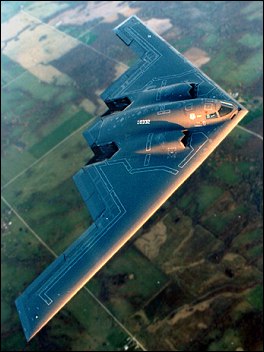
| Development of the B-2 was begun in 1978 and the US Air Force originally wanted 133 examples, but by 1991 successive budget cuts had reduced this to 21 aircraft. The prototype flew on 17 July 1989, and the first production B-2 was delivered to the 393rd Bomb Squadron of the 509th Bomb Wing at Whiteman AFB, Missouri, on 17 December 1993.
In designing the Advanced Technology Bomber (ATB), as the B-2 project was originally known, the Northrop Company decided on an all-wing configuration from the outset. Flying-wing devotees such as Hugo Junkers and Jack Northrop have existed as long as aviation itself, arguing that a flying wing will carry the same payload as a conventional aircraft while weighing less and using less fuel. The weight and drag of the tail surfaces are absent, as is the weight of the structure that supports them. The wing structure
itself is far more efficient because the weight of the aircraft is spread across the wing, rather than concentrated in the centre.
Northrop's experimental piston-engined flying-wing bomber of the 1940s, from which ideas for the B-2 were drawn, was designed to equal the range and carry the same warload as the Convair B-36, but at two-thirds the gross weight and also at two-thirds the power. The company produced a prototype flying-wing jet bomber, the YB-49, in 1947; however, this had little influence on the decision to pursue
an all-wing solution for the B-2; the all-wing approach was selected because it promised to result in an exceptionally clean configuration for minimizing radar cross-section, including the elimination of vertical tail surfaces, with added benefits such as span-loading structural efficiency and high lift/drag ratio for efficient cruise. Outboard wing panels were added for longitudinal balance to increase lift/drag ratio and to provide sufficient span for pitch, roll and yaw control. Leading-edge sweep was selected for balance and trans-sonic aerodynamics, while the overall planform was designed for neutral longitudinal (pitch) static stability. Because of its short length, the aircraft had to produce stabilizing pitchdown moments beyond the stall for positive recovery. The original ATB design had elevons on the outboard wing panels only but, as the design progressed, additional
elevons were added inboard, giving the B-2 its distinctive 'double-W trailing edge. The wing leading edge is so designed that air is channelled into the engine intakes from all directions, allowing the engines to operate at high power and zero airspeed. In trans-sonic cruise, air is slowed from supersonic speed before it enters
the hidden compressor faces of the GE F118 engines.
A stores management processor is in place to hande the B-2's 22,730kg weapons load. A separate processor controls the Hughes APQ-181 synthetic-aperture radar and its input to the display processor. The Ku-band radar has 21 operational modes,
including high-resolution ground mapping. The B-2 lifts off at 260km/h, the speed independent of take-off weight. Normal operating speed is in the high subsonic range and maximum altitude around 15,240m. The aircraft is highly manoeuvrable, with fighter-like handling characteristics.
Robert Jackson "The Encyclopedia of Aircraft", 2004
External links
 | A three-view drawing (767 x 440) |
| CREW | 2-3 |
| ENGINE | 4 x General Electric F-118-GE-100, 78.4kN |
| WEIGHTS |
| Take-off weight | 181437 kg | 400002 lb |
| Empty weight | 45360 kg | 100002 lb |
| DIMENSIONS |
| Wingspan | 52.1 m | 171 ft 11 in |
| Length | 20.9 m | 69 ft 7 in |
| Height | 5.1 m | 17 ft 9 in |
| Wing area | 465.5 m2 | 5010.60 sq ft |
| PERFORMANCE |
| Cruise speed | 1010 km/h | 628 mph |
| Ceiling | 16765 m | 55000 ft |
| Range | 12225 km | 7596 miles |
| ARMAMENT | 22680kg of bombs |
| Anonymous, 25.07.2023 21:10 Xdhseywzhrd74
n3467 reply | | Mike Trout miketrouttriplecrow, 04.03.2013 23:58 My name is Beelzebub, but you can call me Beelz reply |
| Bill, e-mail, 06.12.2012 23:00 I remember the incident with AV-2 and AV-4, which later was nicknamed "Christine" because it would break and fix it self!
(the AF still refers to her by that name) reply | | elijah, e-mail, 28.05.2012 08:07 these planes are iteresting, they are that rare that they each have a unique nickname, eg. spirit razor and ghost are some i know of, there are twenty of them in america. all names have something to do with its characteristics. reply | |
| | elijah, e-mail, 28.05.2012 08:03 The aircraft yaws by altering power between the two engines, eg. to yaw left it will increase power to the right engine, to yaw right it will increase throttle on the left engine. reply | | monkey, 23.09.2011 18:43 24 meters reply | | Bob, 20.07.2011 05:38 In response to comments about the B-2 flying like a fighter,I'd like to make a few comments to clarify this. First, Bruce Hines, the original B-2 test pilot did comment how well the B-2 handled. However, the g forces an aircraft structure is designed for is indicative of it's maneuver cabability. Modern jet fighters are designed for 7.33 to 9.0 g. The B-2 is designed for considerably less than this and therfore cannot compare to a fighters manueverability. reply | | Bob, e-mail, 19.07.2011 21:18 Jack Northrop was brought in to see the full scale mockup. He was very impressed and pointed out similarities to the XB-49. reply | | alex, 08.06.2011 08:04 which aircraft is the one that currently still flies over the AV (palmdale / lancaster area)? is it the f-117 or b-2? reply | | big boom guy, e-mail, 24.03.2011 16:28 big big big boom BIG i say BIG
ADOLF HITLER DEAD PAKIS IN ANGER RAGE AND STEAL AND KILL US reply | | John, e-mail, 15.02.2011 07:47 Anyone who says this bomber (or any bomber) "flies like a fighter" has never flown a fighter. reply | | ED, e-mail, 13.12.2010 01:46 Jack was shown the plans and not a pic of the actual plane as the plane was yet to be built. Anyone recall the LG malfunction with AV-2 when the gear wouldn't retract fully or the electrical fire of AV-4 at Palmdale?. ............emo reply | | Bradyco, e-mail, 10.11.2010 23:28 100,000' and over The GE engines are for lift off and then
positive in the front negative in the rear very little fuel and "refueling" two times to Kosovo was disinformation.
The B-2 stands for Biefield and Brown
The only way you can 'fly" this is by computer
This is just the beginning because this site has only this and not MWLP reply | | J.Cook, e-mail, 28.10.2010 06:34 I'm retired Air Force (26 years) and worked on all three bombers; B-52, B-1, and the B-2 during its test phase at Edwards AFB. Ron is correct on all counts...especially on the TONS of computers! Every system is backed up 2 to 4 times. And I heard several test pilots mention it flew more like a fighter then a bomber. Great Aircraft! reply | |
| | Ron Krause, e-mail, 21.01.2010 00:32 BENEFACTOR- Wrong on all counts, I did low observables on this a /c for 16 years. It lifts off easily after a 300 yd. roll out. Loaded, about 4x the distance.
BRAD- The wing tips are a split design and can open on one side or the other separately causing yaw and can be opened fully on both sides to act as air brakes.
THE WHO- You are correct, it has tons of computers!
TONY- Sadly he did see this shortly before he passed, I'm not sure whether it was a video he saw or the real thing. They say he was very pleased to realize his dream, like you said. The pilots all say that this a /c flies like no other with ease of handling, cruising, take off and landing. They also said it handled like an F-18 or similar type fighter. It has stick and rudder like a fighter. Very cool air vehicle. reply | | benefactor, e-mail, 05.01.2009 01:03 ... it weighs too much to take off with those engines
one sec, gonna look at some designs
.... the leading edge of the wing is charged to millions of volts! POSITIVE, and the exhaust is the same except to NEGATIVE.. Ionization /electro-gravatics anyone???? reply | | Tony, 22.06.2008 19:25 Jack Northrop, ailing and aged, was given special clearance to see this aircraft. His dream had been realized. reply | | THE WHO, 25.03.2008 01:56 IT HAS COMPUTERS TO DO THAT. reply | | brad, e-mail, 29.07.2007 20:16 how deoes this air craft yaw reply | | tariq, e-mail, 15.07.2007 22:39 what is the cruise height? reply |
|
Do you have any comments?
|
| 
COMPANY
PROFILE
All the World's Rotorcraft
|


 Mike Trout miketrouttriplecrow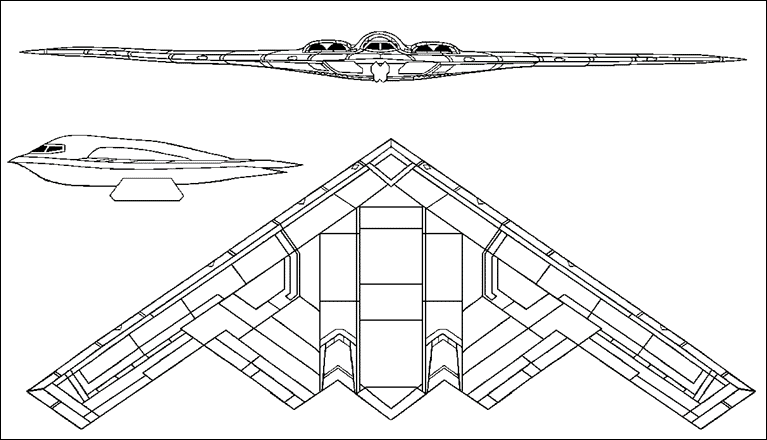


mes470545uttjr 83V0ETW 4vAt pbC1qI5
reply