|
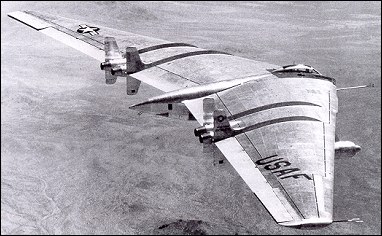
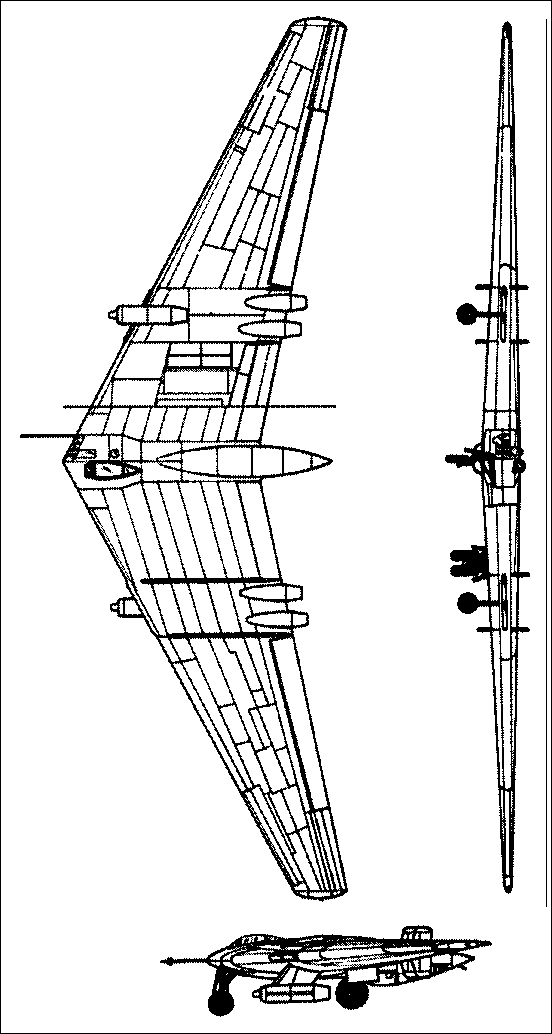
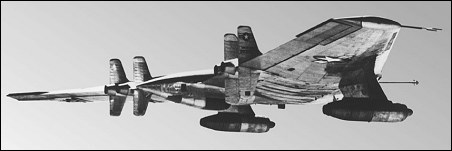
| A last chance for the flying wing design was the YRB-49, a six-engined reconnaissance bomber, with two engines in underwing nacelles to increase the volume available for fuel. But the RB-49 offered no real advantages over the B-47 and the new B-52, and production was canceled before the single YRB-49 flew on May 4, 1950.
 | A three-view drawing (552 x 1034) |
| MODEL | YRB-49 |
| ENGINE | 6 x Allison J35 turbojets, 1870kg |
| DIMENSIONS |
| Wingspan | 52.4 m | 172 ft 11 in |
| Length | 16.2 m | 53 ft 2 in |
| Wing area | 372 m2 | 4004.17 sq ft |
| Terrence O'Neill, e-mail, 22.05.2008 16:40 For the facts, from gov't microfilm recodrds of the development programs, etc., read my new book: "GM,DS! A Billion Dollar Blunder".
The YRB-49A contract originally specified eight J-47s, which the Generals soon changed to six stove-pipe J-35s to cripple its performance and image. However, thanks to Charles Tucker's test piloting and input it had both pilots in the bubble, a G-meter (for stall recovery without pulling off the wings), and a jettisonable canopy, and a yaw-stabilizing auto-pilot, which made it an excellent, superior aircraft. With jet engines it was a 2000-mile-target aircraft, not the 4000-mile-target bomber SAC needed for the USSR's war-making plants in the Urals... for which the B-35 was designed and was greatly superior, had Pratt&Whitney and the AAF not refused to fix the torsional-resonance problems with the contra-rotating very efficient Hamilton Standard props... which the AF refused to perform engine-prop compatibility tests on. The 4000-mile-target 4-engine B-35 was superior in every way to the B-36. And the 2000-mile-target B-49 was superior in every way to the 1500-mile-target Boeing B-47.
Any airplane designer can see how the AF dunced the politicians and the dumb-media around by using bogus gross weights and false claims about instability and speeds. My book lays out the simple faces, from gov't records and biographies of the people involved. reply | | Anthony Lopez, e-mail, 12.04.2008 21:12 I was living in Baldwin Park CA and saw it fly over. saw black jet exhaust. I was thirteen years old never forgot that sight. reply | | stephen winkler, e-mail, 27.03.2007 00:33 This was only the second bomber design submitted by Northrop and was based on the earlier XB-35 piston-powered aircraft. Like the XB-35, it had stability problems.
Many in the defense establishment favored a supercarrier, rather than the development of colossal bombers. Incidentally, the most distinguished of the giant bomber designs of that time was the Convair B-36. However, the B-36 was a World War II design developed to bomb Germany in the event that Germany crushed Great Britain. Certainly, the final developement of the Boeing B-29 in the form of the B-54 offered the prospect of a proven design with the new Pratt and Whitney R-4360-43 Wasp Major turbocompound engines. However, niether the B-36 nor the B-54 could penetrate radar and the B-49 could avoid and evade Soviet defenss mechanisms. However, it lacked the capacity and the range of the B-36 and of the four suggestions examined by the Truman Administration, the Convair B-36 won over the supercarrier, the B-49, and the B-54 as the best investment for national defense. reply |
|
Do you have any comments?
|
| 
COMPANY
PROFILE
All the World's Rotorcraft
|