|
| By the early 1980s there were few aviation records that had not been already set or achieved. The Rutan Voyager which was conceived in 1981 would in one flight become the first aircraft to fly nonstop around the world without refuelling, so breaking the records for the longest timed flight and the longest distance flight. Burt Rutan utilized his experience in the design of ultra-light home-build aircraft such as the VariViggen and the VariEze when he and brother Dick Rutan, along with Jeana Yeager, determined to try to gain the Collier Trophy. Dick Rutan, a former Vietnam fighter pilot, and Yeager had already set a
number of lesser records in earlier Burt Rutan designs.
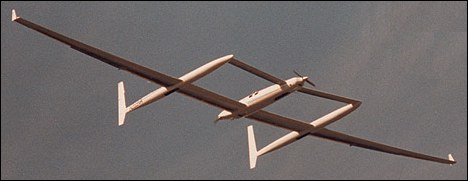
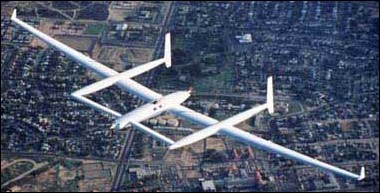
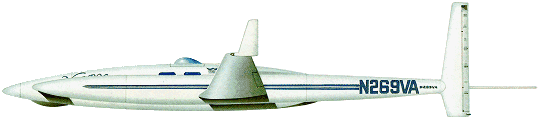
Configuration of the Voyager's design was itself extraordinary. There were two engines mounted at either end of the cockpit, but the forward tractor mode engine was only utilized during take-off and the initial 70 hours of the journey when the Voyager was at its heaviest. Similar to earlier Rutan designs, there was a forward canard wing accompanied by a rear main wing, but the Voyager's design connected these by means of a twin boom fin arrangement. The cockpit and single cabin accommodation were side by side. Composite materials, including graphite fibre, kevlar and paper honeycomb, accounted for 98% of the Voyager's airframe and no metals were used. In fact,
substantial parts of the Voyager's structure were manufactured of this specially treated paper.
Construction of the Voyager began in 1982 at Mohave in California, with the project being funded by private means and donations. Successful completion resulted in a first flight on 22 June 1984. The unladen weight of the Voyager was a mere 425kg and the flexibility of the wing caused a deflection of up to 1.5m in flight. The aircraft was designed to carry a vast amount of fuel for the unrefuelled flight around the Earth and the 3181kg capacity was distributed around 17 tanks aboard the craft, accounting for over 70% of its gross weight. Regular rebalancing of this load between tanks would be an important feature of the in-flight
duties. The accuracy of Rutan's calculations was so critical that only 48kg of fuel remained at the end of the Voyager's historic flight.
The Voyager, crewed by Dick Rutan and Jeana Yeager, required the full length of the runway at Edwards Air Force Base, California, in order to lift off at 08:01 Pacific time on 14 December 1986, and the wobble of the wings caused their tips to scrape the runway. The loosened tips had to be released in flight by airframe manipulation, but there was no critical damage. The routing of the Voyager took into account avoidance of severe weather, including typhoons, and had to negotiate the geo-political realities of that era. Critical failures were limited to a fuel blockage in the rear engine that occasioned
temporary restart of the frontal unit. However, the flight lasted nine days until the Voyager touched down back at Edwards Air Force Base at 08:05 on 23 December 1986. The physical and mental strain placed upon the crew in this confined space, under constant pressure, was as much a feat of endurance as that of the machine itself. A record for the first unrefuelled flight around the world had been made, and the distance record - previously held by a B-52 - was doubled. The Voyager had earned its place at the Smithsonian Museum, Washington DC, where it resides today.
Robert Jackson "The Encyclopedia of Aircraft", 2004
| CREW | 2 |
| ENGINE | 1 x 110hp Teledyne Continental IOL-200 (rear) + 130hp Teledyne Continental O-240 (nose) |
| WEIGHTS |
| Take-off weight | 4397 kg | 9694 lb |
| DIMENSIONS |
| Wingspan | 33.80 m | 111 ft 11 in |
| Length | 8.90 m | 29 ft 2 in |
| Height | 3.10 m | 10 ft 2 in |
| PERFORMANCE |
| Cruise speed | 186 km/h | 116 mph |
| Range | 40252 km | 25012 miles |
| Michael Cote, e-mail, 10.02.2017 05:56 Do they have a RC model of the voyager? I also would like to see plans and more pictures of the voyager. reply | | Michael, e-mail, 29.01.2015 03:23 I had the pleasure of meeting Jeana Yeager in 2007 and worked for her and her significant other Al Rinehart in north Texas on their quarter horse ranch. She is one tuff lady, couldn't out work her on my best day! This lady is one class act as well as her man Al. P.s. She still a gorgeous women at the age of 62 years young. reply | | Bob Franz, e-mail, 07.02.2014 22:25 I first learned about the Voyager project when I went to San Gabriel airport to hear Dick and Jeana talk about it. I was so enthralled at their plans to fly around the world non-stop and un-refueled that I gave them a $100 donation. It was thrilling to watch it land at Edwards AFB at the end of its historic flight. I heartily recommend reading Phil Patton's book called "Voyager."
I question the statement made in the initial write-up "The cockpit and single cabin accommodation were side by side." It is my understanding that the fuselage was only wide enough for one person - that being the pilot - with the non-pilot being immediately behind the pilot and directly in front of the rear engine. The changeover from front to back and back to front required a lot of effort while still keeping control of Voyager. One of my cherished possessions is a letter I received from Jeana Yeager during the development. reply | | Fred A., e-mail, 09.02.2013 08:55 My wife and I lived in Bakersfield 60 miles from Mojave & Edwards Airforce Base. We went over to Mojave several times to watch the construction of this aircraft. We were fortunate to be there for the takeoff and landing at Edwards. reply | |
| | Chris Christiansen, e-mail, 09.02.2013 06:17 True.... its flight path was within the Northern Hemisphere, but flew as close to the equator as weather and safety conditions would allow. The Earth's equatorial circumference
is 24,901 miles. Voyager flew a confirmed 25,012 miles.
Most would agree that warrants an "around the world" claim. reply | | Aeroman, e-mail, 15.07.2012 03:20 This machine only circled the Northern hemisphere not the equator. reply | | TheOD, e-mail, 04.06.2012 01:57 Is that the same Jeana Yeager that worked with Bob Truax making his rocket. She sure is pretty!!! reply | | Roy Tuason, e-mail, 03.11.2011 11:52 As a technician with Hexcel I attended a company meeting for Dick Rutan and Jeana Yeager in 1987. What a flight milestone! They described their flight and some harrowing experiences. Hexcel honeycomb held the Voyager together. reply | | Paul, e-mail, 06.10.2010 00:22 Watched Dick and Jeana come home to Edwards after that loooong flight. What a wonderful experience even from the ground.
(I've got a VHS video I took of the landing someplace.)
Good memories... reply | | Juan Paz, e-mail, 24.06.2010 18:53 Hello, has anybody a plan or all-view fotos of the Voyager?I like to build a model. Or has somebody information where to get a construction-plan? Please send me a mail. Thanks reply | | Juan Paz, e-mail, 24.06.2010 18:54 Hello, has anybody a plan or all-view fotos of the Voyager?I like to build a model. Or has somebody information where to get a construction-plan? Please send me a mail. Thanks reply | | Juan Paz, e-mail, 24.06.2010 18:53 Hello, has anybody a plan or all-view fotos of the Voyager?I like to build a model. Or has somebody information where to get a construction-plan? Please send me a mail. Thanks reply | | Jim Fackler, e-mail, 25.01.2010 01:59 The scraping of the wings was not due to wiggle in the wings. The Voyager has three main landing gear and they pumped up the main struts because of the flight weight causing negative AOA during takeoff. The wingtips were driven into the runway! reply | | Leo Rudnicki, e-mail, 02.06.2009 17:55 Too fragile and unstable for modelling, unless you enjoy repairing after the crash. reply | |
| | Richard Lee, e-mail, 02.06.2009 08:16 Voyager would make a wonderful scale rubber powered model aircraft.
Is there a good 3-view anywhere? reply | | ADC, e-mail, 06.11.2008 21:15 www.aircrafts-design-center.net reply |
|
Do you have any comments?
|
| 
COMPANY
PROFILE
All the World's Rotorcraft
|